

What Is Digital Marketing? A Complete Guide for Businesses
Digital marketing
This is one of the most effective ways for businesses to reach potential customers, build brand awareness, generate leads, and increase sales in today’s connected world.
Whether you’re a small local business, startup, e-commerce company, or established enterprise, understanding digital marketing can help you create a stronger online presence and compete more effectively.
In this guide, you'll learn:
- What digital marketing is?
- Why digital marketing is important?
- The major types of digital marketing?
- How digital marketing works?
- How to create a digital marketing strategy?
- How to measure digital marketing success?
- Common digital marketing mistakes?
- Frequently asked questions?
What Is Digital Marketing?
Digital marketing is the process of promoting a business, product, service, or brand through digital channels and online technologies.
These channels can include search engines, websites, social media platforms, email, online advertising, video platforms, mobile applications, and other digital channels.
Unlike traditional marketing, digital marketing allows businesses to reach specific audiences, track campaign performance, analyze customer behavior, and optimize marketing activities based on real-time data.
Simple Example:
Imagine someone searches Google for:
“Best digital marketing agency near me.”
If your business appears in the search results, that is an example of SEO. If your business appears as a sponsored advertisement, that is paid search advertising.
If the person discovers your company through Instagram, that is social media marketing.
If they receive a promotional email from your business, that is email marketing.
All of these activities are part of digital marketing.
Why Is Digital Marketing Important for Businesses?
Consumers now use digital channels throughout the buying journey.
They may search for products on Google, watch product videos on YouTube, compare businesses on social media, read online reviews, and ultimately purchase through a website or mobile application.
Digital marketing helps businesses:
- Reach potential customers online
- Increase brand visibility
- Generate qualified leads
- Drive website traffic
- Increase sales and revenue
- Build customer relationships
- Reach specific audiences
- Measure marketing performance
- Improve campaigns using data
For many businesses, having a strong digital marketing strategy is no longer optional. It is an important part of sustainable business growth.
Types of Digital Marketing
Digital marketing consists of several different channels and strategies. Businesses can combine these channels depending on their goals and target audience.
1. Search Engine Optimization (SEO)
Search Engine Optimization (SEO) is the process of improving a website so that it can appear more prominently in organic search-engine results.
SEO can involve:
- Keyword research
- On-page optimization
- Technical SEO
- Content creation
- Internal linking
- Website speed optimization
- Mobile optimization
- Local SEO
- Link building
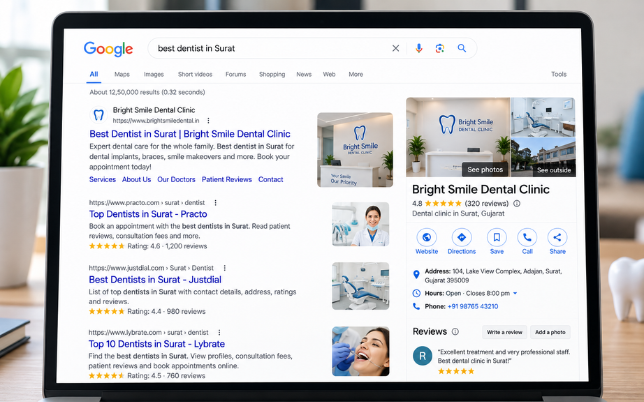
A dental clinic could create a page targeting:
2. Search Engine Marketing and PPC Advertising
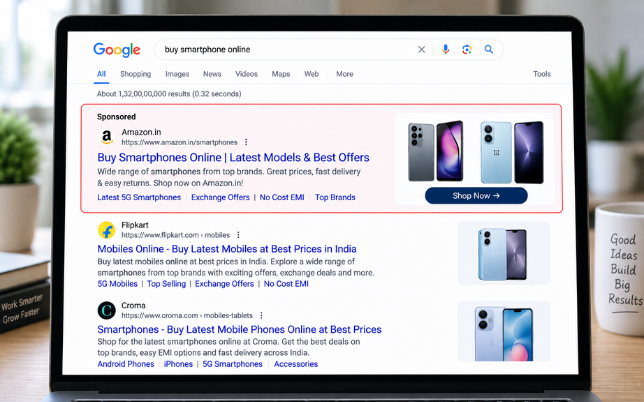
Paid search advertising allows businesses to display advertisements to people searching for relevant products or services.
For example, a business could advertise for keywords related to its services and send visitors to a dedicated landing page.
PPC campaigns can help businesses:
- Generate immediate traffic
- Reach high-intent customers
- Control advertising budgets
- Test different offers
- Measure conversions
Search page for “Buy smartphone online” with a clearly marked Sponsored advertisement at the top.
3. Social Media Marketing
Social media marketing involves using platforms such as Instagram, Facebook, LinkedIn, YouTube, and TikTok to connect with audiences.
Businesses can use social media to:
- Build brand awareness
- Share educational content
- Showcase products
- Generate leads
- Engage with customers
- Drive website traffic
- Run paid advertising campaigns
The best social media platform depends on the target audience and type of business.
Smartphone showing an Instagram-style clothing advertisement with a Shop Now button.

4. Content Marketing
Content marketing focuses on creating useful, relevant, and valuable content for your target audience.
Common examples include:
- Blog posts
- Guides
- Case studies
- Videos
- E-books
- Infographics
- Webinars
- Podcasts
The objective isn’t simply to publish content. Good content should answer customer questions, solve problems, establish expertise, and support the buying journey.
Laptop displaying a business blog article titled “10 Best Home Exercises for Beginners.”

5. Email Marketing
Email marketing allows businesses to communicate directly with subscribers and customers.
Common email campaigns include:
- Welcome emails
- Newsletters
- Promotional campaigns
- Product recommendations
- Abandoned-cart emails
- Educational sequences
- Customer retention campaigns
Email marketing can be particularly useful for nurturing leads and maintaining relationships with existing customers.
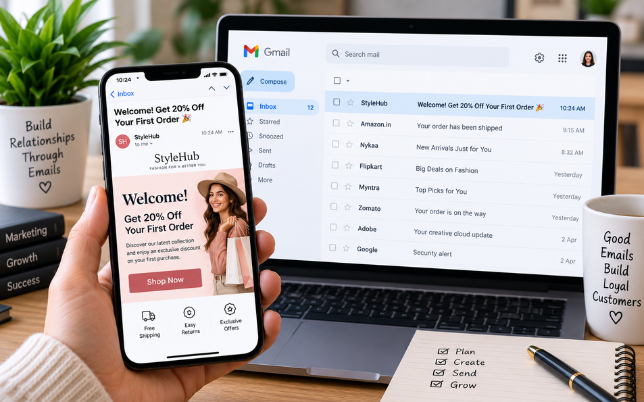
Phone or laptop displaying a marketing email saying “Welcome! Get 20% Off Your First Order.”
6. Influencer Marketing
Influencer marketing involves collaborating with content creators or industry personalities who have an established audience.
The most effective influencer isn’t necessarily the person with the largest following.
A smaller creator with a highly relevant and engaged audience can sometimes be more valuable than a celebrity with millions of followers.
Tech creator recording a smartphone review with a camera/tripod and the product visible.

7. Affiliate Marketing
Affiliate marketing is a performance-based marketing model.
An affiliate promotes a company’s product or service and receives a commission when a qualifying sale or conversion occurs.
This can allow businesses to expand their reach while paying primarily for measurable results.
Laptop showing a “10 Best Headphones” review article with product recommendations and Buy Now affiliate buttons.

8. Video Marketing
Video marketing uses video content to educate, entertain, demonstrate products, or build trust.
Popular formats include:
- YouTube videos
- Short-form videos
- Tutorials
- Product demonstrations
- Customer testimonials
- Webinars
- Live streams
Video can be especially effective for explaining complex products or demonstrating how something works.
Laptop showing a YouTube-style wireless headphones product demonstration/tutorial.:

How Does Digital Marketing Work?
A typical digital marketing funnel can be represented as:
Awareness → Interest → Consideration → Conversion → Retention → Advocacy
For example:
1. Awareness
A potential customer discovers your brand through Google or social media.
2. Interest
They visit your website and read useful content.
3. Consideration
They compare your product or service with alternatives.
4. Conversion
They contact your business or make a purchase.
5. Retention
You continue communicating with them through email, content, or customer support.
6. Advocacy
A satisfied customer recommends your business to others.
A strong digital marketing strategy supports customers throughout this entire journey.
Digital Marketing vs. Traditional Marketing
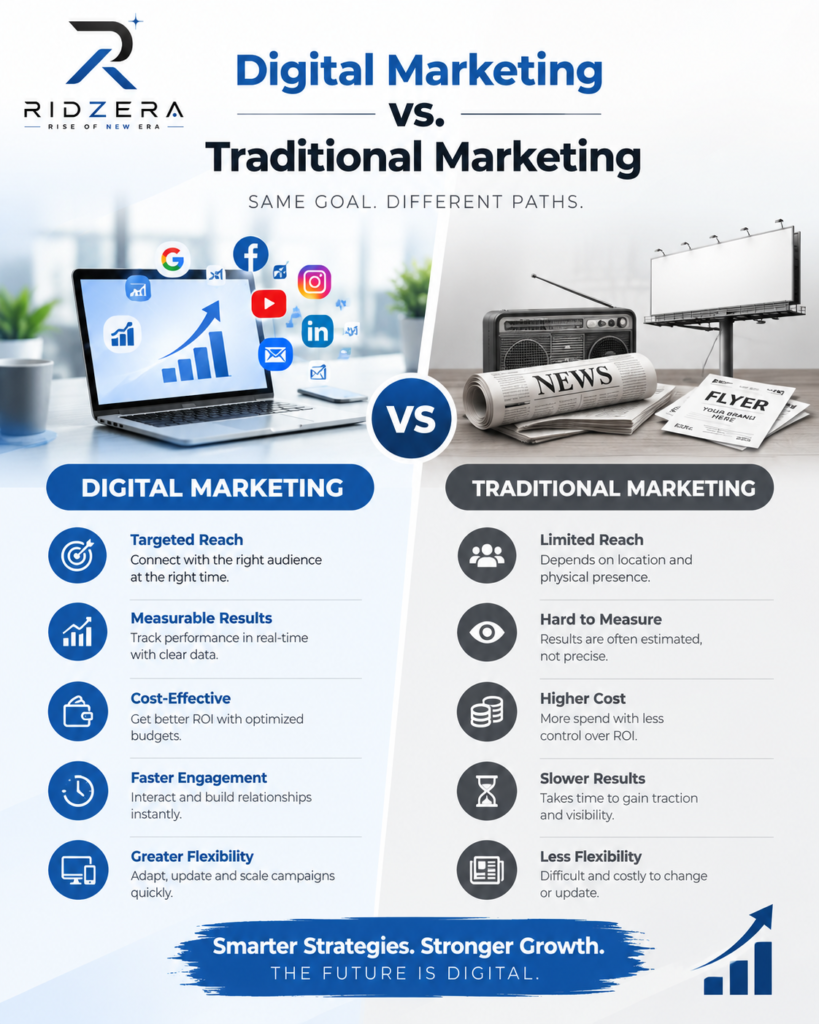
DIGITAL MARKETING
Search Engines
Social Media
Email
Websites
Online advertising
Video platforms
Highly measurable
Advanced audience targeting
TRADITIONAL MARKETING
Newspaper
Television
Radio
Billboards
Direct mails
Print advertising
Often harder to measure precisely
Generally broader targeting
Digital and traditional marketing don’t necessarily need to compete with one another. Many successful businesses use both.
Benefits of Digital Marketing
Targeted Reach
Digital platforms allow businesses to target specific audiences based on factors such as location, interests, demographics, behavior, and search intent.
Measurable Performance
Businesses can track traffic, leads, conversions, revenue, advertising costs, and other important metrics.
Cost Flexibility
Businesses can start with a small budget and scale campaigns based on performance.
Global Reach
Digital channels can allow businesses to reach customers far beyond their physical location.
Personalization
Businesses can tailor content and offers to different customer segments.
Faster Optimization
Campaign data can help marketers identify what is working and make changes more quickly.
How to Create a Digital Marketing Strategy
Step 1: Define Your Goals
Start with specific, measurable objectives.
Instead of:
“We want more customers.”
Use:
“We want to generate 100 qualified leads per month through organic search and paid advertising.”
Step 2: Identify Your Target Audience
Define:
- Who your customers are
- What problems they have
- What they want
- What influences their decisions
- What questions they ask
- Where they search for information
The more clearly you understand your audience, the more relevant your marketing becomes.
Step 3: Research Your Competitors
Analyze your competitors’:
- Websites
- Search rankings
- Content
- Social media
- Advertising
- Offers
- Customer reviews
Look for gaps and opportunities rather than simply copying competitors.
Step 4: Select the Right Channels
You don’t need to use every marketing channel.
For example:
B2B business:
SEO + LinkedIn + Email + Webinars
E-commerce business:
SEO + Social Media + Paid Advertising + Email
Local business:
Local SEO + Google Business Profile + Social Media + Reviews
Choose channels based on where your target customers are and how they make purchasing decisions.
Step 5: Create Valuable Content
Create content that helps your audience solve real problems.
Your content strategy can include:
- Educational articles
- Product guides
- Case studies
- Videos
- FAQs
- Customer stories
- Industry insights
Focus on quality, relevance, and usefulness rather than simply publishing as much content as possible.
Step 6: Launch and Test
Test different:
- Headlines
- Images
- Videos
- Offers
- Landing pages
- Calls to action
- Keywords
- Audiences
Use performance data to determine what works best.
Step 7: Measure and Improve
Digital marketing is an ongoing process.
Review your data regularly and improve campaigns based on actual results.
Important Digital Marketing Metrics
Different campaigns require different KPIs.
SEO Metrics
- Organic traffic
- Keyword rankings
- Click-through rate
- Organic conversions
Social Media Metrics
- Reach
- Engagement
- Video views
- Clicks
- Leads
Paid Advertising Metrics
- Impressions
- Click-through rate
- Cost per click
- Cost per lead
- Conversion rate
- Return on ad spend
Business Metrics
- Revenue
- Customer acquisition cost
- Customer lifetime value
- Lead-to-customer conversion rate
Remember: followers, likes, and impressions can be useful indicators, but business results should ultimately be the priority.
Common Digital Marketing Mistakes
Avoid these common mistakes:
1. Trying to Use Every Platform
Focus on the channels that matter most to your audience.
2. Targeting Everyone
A clearly defined audience usually produces more relevant marketing.
3. Focusing Only on Traffic
Website traffic is valuable only when it contributes to meaningful business outcomes.
4. Ignoring SEO
SEO can become an important long-term source of relevant organic traffic.
5. Creating Content Without a Strategy
Every piece of content should have a purpose and target audience.
6. Expecting Instant Results
Some channels, particularly SEO and content marketing, can require consistent effort before producing significant results.
7. Not Measuring Conversions
Don’t stop at clicks. Track what happens after the click.
How Much Does Digital Marketing Cost?
There is no fixed price for digital marketing.
The cost depends on:
- Business size
- Industry
- Competition
- Target market
- Marketing channels
- Advertising budget
- Content requirements
- In-house resources
- Agency fees
A small business may begin with organic SEO, content marketing, and social media, while a larger company may invest in paid advertising, marketing automation, analytics, content production, and multiple specialized teams.
The goal should not simply be to spend more.
The goal should be to generate a positive return from marketing investment.
CONCLUSION
Digital marketing is more than simply posting on social media or running online advertisements.
It is a complete approach to attracting potential customers, building relationships, generating demand, increasing conversions, and retaining customers through digital channels.
Whether you’re launching a new business or expanding an established company, a well-planned digital marketing strategy can help you build a stronger online presence and create sustainable growth.
Ready to grow your business online?
[Get a Free Digital Marketing Consultation →]
What to Prepare Before Running Your First Paid Ad?
Running your first paid ad is an exciting step for your business. It puts your message in front of potential customers and gives you a chance to learn what gets their attention.
But launching an ad is only part of the process. What happens after someone clicks matters just as much as the ad itself.
Before you start spending, prepare these essentials to give your campaign a clear purpose and your visitors a reason to take action.
1. Choose One Clear Goal
Start with a simple question: What do you want someone to do after seeing your ad?
You might want them to buy a product, book a consultation, request a quote, or sign up for your newsletter.
Choose one primary goal for your first campaign. This makes it easier to write a focused message, choose a destination page, and decide what success looks like.
For example, if you want consultation bookings, measure completed bookings. Clicks can tell you whether people are interested, but they don’t tell you whether your campaign is delivering its intended result.
2. Know Who You Want to Reach
Trying to appeal to everyone can leave your message feeling vague. Before writing your ad, describe the person most likely to benefit from your offer.
Consider:
What problem are they trying to solve?
What would make them look for a solution now?
What questions or concerns might stop them from buying?
What do they need to know before trusting your business?
Use those answers to shape your message. An ad for a busy business owner, for example, might highlight time saved and a straightforward setup process.
3. Prepare a Compelling Offer
Your audience needs a clear reason to take the next step.
An offer could be a product with a specific benefit, an introductory service package, a free consultation, or a useful downloadable guide. It doesn’t have to involve a discount.
Make sure someone can quickly understand what they’ll get, why it matters, and what they need to do next. Be clear about prices, eligibility, or other conditions that could affect their decision.
4. Get Your Landing Page Ready
Your landing page is where visitors arrive after clicking your ad. It should continue the same message and make the promised next step easy.
Before launching, check that the page has:
A headline that matches the ad’s promise.
A clear explanation of the offer.
Relevant images and genuine proof, such as customer reviews.
One prominent call to action.
A working form, booking tool, or checkout.
Test the page on your phone, too. Read the text, tap the buttons, and complete the process yourself. Remove anything that makes the experience confusing or difficult.
5. Set a Budget and Testing Plan
Decide how much you’re comfortable spending on an initial test and what you want to learn from it.
Your first campaign can help you explore whether an audience responds to your offer, which message creates interest, and whether your page turns that interest into action.
Keep the test manageable. Start with a small number of ad variations and change one major element at a time, such as the headline or image. Set a review point in advance so you can assess results without reacting to every daily fluctuation.
6. Prepare Your Ad Content
Strong ad content makes the value of your offer easy to understand.
Write a headline that speaks to a relevant need, supporting copy that explains the benefit, and a call to action that tells people what to do next.
Use visuals that support the message and accurately represent what you’re offering. Check spelling, links, and consistency between the ad and its destination before publishing.
7. Set Up Measurement and Follow-Up
Make sure you can track the action your campaign is designed to generate. Test your setup before launch and confirm that a completed enquiry, booking, or purchase is recorded correctly.
Also prepare for what happens next. Who will respond to enquiries? Will customers receive a confirmation? Is your team ready to fulfil orders or deliver the service?
An ad can start a conversation. A clear, timely follow-up helps move it forward.
Ready to Launch?
Before you publish, walk through the full customer journey: view the ad, open the page, complete the action, and check the follow-up.
You don’t need a perfect campaign to begin. You need a clear goal, a relevant offer, a working customer experience, and a way to learn from the results.
AI Marketing Trends Businesses Need to Know in 2026
Artificial intelligence is changing how customers discover businesses, how marketing campaigns run, and how teams create content. For business owners, the challenge is deciding which changes deserve attention—and where to start.
In 2026, several developments have practical implications for businesses of every size. Here are the AI marketing trends worth understanding and how to prepare for them.
1. AI Search Is Changing How Customers Find Businesses
Search now includes experiences where people ask detailed questions, compare options, and receive AI-generated answers with links to supporting websites. Google’s AI Overviews and AI Mode are examples of this shift. Google Search Central
For businesses, this creates another way for potential customers to discover their expertise. Your website needs to explain what you offer clearly and answer the questions people ask before making a decision.
What to do: Build useful service pages, FAQs, and comparison guides based on real customer questions. Include specific examples, accurate business information, and evidence for your claims.
Google says its existing SEO fundamentals still apply to these experiences; there is no special markup required to appear in them. Keep your focus on helpful content and a technically accessible website. Google’s guidance for AI search
2. AI Agents Are Moving Into Marketing Workflows
AI is expanding beyond generating individual pieces of text. Marketing platforms now offer agents designed to coordinate multiple steps across content production, campaign work, and approvals. Adobe, for example, describes agents that plan and execute tasks across connected business systems. Adobe’s agentic AI overview
The practical opportunity is to reduce repetitive coordination. A workflow might turn an approved campaign brief into draft assets, organise them for review, and route them to the right person.
What to do: Start with one clearly defined process. Specify the information the agent can use, the actions it can take, and the points where someone must review its work.
Measure the time saved alongside the corrections required. A faster workflow is useful only if the output is reliable.
3. Personalisation Is Becoming More Connected
AI marketing platforms are combining customer information with tools that tailor messages across different touchpoints. Adobe’s customer engagement offering, for example, uses AI to connect customer insights with personalised experiences. Adobe’s customer engagement overview
For a business, the opportunity is to make communication more relevant. A first-time visitor may need an introduction to your services, while a returning customer may benefit from guidance related to an earlier purchase.
What to do: Begin with a few meaningful customer groups and a clear reason to communicate with each one. Keep your customer records accurate and respect people’s communication preferences.
Personalisation should make the experience more helpful. Adding someone’s name to a generic message is only a starting point.
4. Advertising Automation Makes Clear Goals Essential
Automated advertising is already established. Google’s Performance Max campaigns, for example, bring multiple advertising channels into a single campaign. This remains relevant as businesses plan their marketing in 2026. Google’s Performance Max overview
The practical implication is that campaign preparation matters. Businesses still need to define a valuable conversion, provide strong creative material, and understand whether the enquiries or purchases generated support their goals.
What to do: Check your conversion tracking before increasing spend. For lead generation, review whether enquiries become qualified prospects and customers. For online sales, consider profitability as well as revenue.
Use automation with regular performance reviews and a clear testing budget.
5. AI-Generated Advertising Is Bringing Transparency Into Focus
As AI becomes part of creative production, advertising platforms are giving users more information about how ads were made. Google introduced information identifying AI-created or edited advertisements in 2026, following similar moves by Meta. The Verge’s reporting on AI ad labels
For businesses, this makes the accuracy of creative material especially important. A polished image should still represent the product honestly, and a persuasive message should use claims the business can support.
What to do: Create a review checklist for AI-assisted content. Check facts, product details, visual accuracy, and brand voice before publishing. Use genuine customer testimonials and verify the disclosure requirements of the platform you advertise on.
How to Put These Trends Into Practice
You don’t need to introduce every AI capability at once. Choose a task with a clear business benefit, such as improving service-page content, reducing campaign preparation time, or making customer follow-up more relevant.
Record how the process performs today, test one change, and compare the results. Include time spent reviewing and correcting AI output in your assessment.
The most useful AI marketing strategy for 2026 starts with a customer need and a measurable goal. Choose the technology that helps you serve that need, then refine how you use it as you learn.
BLOG TOPICS: